Basketball Sister Applique
First Impression: Bold, Playful, and Instantly Relatable
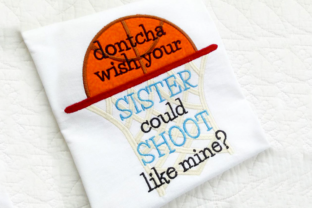
As an embroidery designer who’s prepped over 200 craft fair booths, my gut reaction to Basketball Sister Applique is immediate: it’s bold, witty, and emotionally resonant. The phrase “Dontcha wish your SISTER could SHOOT like mine” lands with cheeky confidence—not sarcastic, not forced, but warmly competitive in that unmistakable sibling way. Paired with a basketball and hoop, the design reads as modern sporty rather than generic athletic. It avoids cliché mascots or aggressive fonts; instead, it leans into personality, making it ideal for handmade markets where authenticity sells.
Where It Shines: Craft Fair Products That Turn Heads
In a crowded booth full of tea towels and tote bags, Basketball Sister Applique stands out best when scaled intentionally. On a medium-sized tote bag (14–16″ wide), centered above the pocket or across the front panel, it commands attention without overwhelming. As an apron embroidery, placed just below the bib or on the lower corner of the waistband, it adds charm and specificity—especially at youth sports tournaments or school spirit fairs.
It’s also a natural fit for embroidered patch production. Stitched cleanly onto twill or denim, it becomes a collectible badge of sister pride—perfect for pinning to backpacks, jackets, or market bags. On tea towel embroidery, I recommend placing it near the top hem (not centered) to preserve drying function while keeping the message visible when hung. For pillow covers and small fabric pouches, scale it down slightly—but never below 3.5″ wide—to retain legibility of the playful text.
What Works Online—and What Doesn’t
This machine embroidery design photographs exceptionally well for Etsy listings and social previews. The contrast between sporty subject matter and warm, familial tone creates strong visual storytelling. A printable mockup showing it stitched on a natural canvas tote against a wood table? Instant click-through. But beware: on dark fabric or heavily textured towels, letter clarity suffers unless thread contrast is dialed in early. Always test stitch on scrap fabric matching your final product’s weight and nap.
The phrase “Dontcha wish your SISTER could SHOOT like mine” relies on rhythm and emphasis—not just words. That means tiny details matter: the capitalization of “SISTER” and “SHOOT”, the spacing around “Dontcha”, and the curve of the basketball hoop must all hold up at 4–5″ wide. If the stitch density is too high in the hoop area, it’ll pucker on lightweight cotton. Too low, and the basketball loses dimension. This isn’t a “set-and-forget” digital embroidery file—it rewards thoughtful execution.
Production Realities: Speed, Scale, and Stability
For batch production, Basketball Sister Applique is highly repeatable—if you respect its structure. It’s not minimalist, but it’s not overly complex either. No fine gradients or micro-details that demand specialty needles or ultra-slow speeds. That said, the basketball texture and hoop outline require consistent tension and proper stabilizer. Use medium-weight cutaway for caps and structured pouches; tear-away works for tea towels and aprons—*if* the fabric isn’t too stretchy.
Hoop size matters more here than you’d think. Because the design includes both tall vertical text and a horizontal hoop, a 5×7″ hoop fits comfortably—but avoid cramming it into a 4×4″ without adjusting proportions. And yes, curved cap surfaces *will* distort the hoop shape if hooping isn’t precise. Always do a test run on a cap blank before committing to 20 units.
Careful-Use Notes You Can’t Skip
- Dense stitch areas: The basketball’s pebble texture and hoop outline pack moderate density—watch for gapping on thin fabrics or shadowing on dark thread over light fabric.
- Tiny details: The “i” dots and apostrophe in “Dontcha” are small—confirm they’re legible at your smallest intended size (no smaller than 3.25″ wide).
- Small lettering: “like mine” sits low and compact—avoid shrinking further than 10 pt equivalent in stitch height.
- Textured towels & thick fabric: Terry cloth absorbs stitches quickly. Use topping stabilizer (e.g., water-soluble film) to keep text crisp.
- Dark fabric: White or neon yellow thread pops best—never rely on default auto-thread suggestions.
Booth Impact: How It Builds Your Brand and Drives Sales
In person, Basketball Sister Applique does three things exceptionally well: sparks conversation (“Oh my gosh—that’s *so* us!”), signals niche awareness (sports + sisterhood = emotional targeting), and elevates perceived value. A $28 embroidered tote with this design feels more intentional—and more giftable—than a generic monogram. It strengthens brand consistency for shops focused on family, youth sports, or girl-powered themes.
At craft fairs, I always place one finished product—a cap, a pillow cover, and a patch sampler—on a stand near eye level. When customers pause, point, and say “I need that for my little sister,” you know the design is working. That moment is worth more than five generic “Team Mom” slogans combined.
Final Designer Checklist Before You Stitch
- Test the embroidery file on scrap fabric matching your final product’s weight and texture.
- Check thread contrast—especially for “SISTER” and “SHOOT”—against both light and dark backgrounds.
- Review spacing between text lines and basketball elements—tight gaps can vanish in stitching.
- Confirm hoop size compatibility with your machine and intended product (e.g., cap frames vs. flat hoops).
- Inspect stitch density visually—look for crowding in the hoop curve and basketball seams.
- Use the right stabilizer: cutaway for structured items, tear-away + topping for textured towels.
- Create at least one real-world mockup—not just digital—before listing or printing labels.
- Compare how it looks on multiple fabric colors: oat, navy, black, and kraft brown tell different stories.
- Verify commercial licensing terms before selling finished products—this is essential for any commercial embroidery use.
Bottom line? Basketball Sister Applique isn’t just another Sports design—it’s a conversation starter, a handmade differentiator, and a smart addition to any small shop product lineup. With thoughtful execution, it turns everyday items into meaningful, market-ready craft fair products that sell themselves.