Flag of Egypt Embroidery Design Review
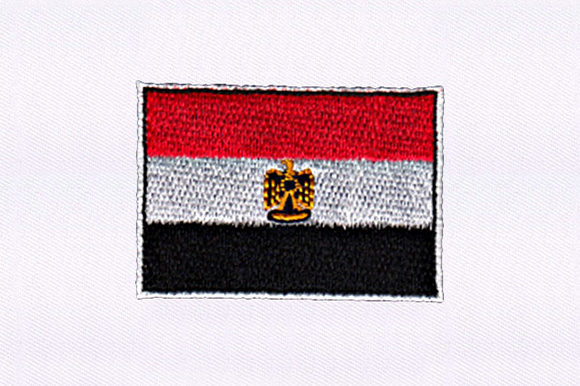
As a designer who’s stitched over 200 national flag motifs for apparel, nursery decor, and boutique merchandise—most recently a run of embroidered linen tea towels for a Cairo-themed pop-up—I approached the Flag of Egypt machine embroidery design with both familiarity and fresh scrutiny. This isn’t just another vector-to-stitch conversion. It’s a symbol with weight: bold red, white, and black bands; the centered Eagle of Saladin in gold or metallic thread; and subtle but essential proportion balance that makes or breaks recognition at a glance.
A First Stitch Tells You Everything
The Flag of Egypt lands with quiet authority—not flashy, not fussy. Its layout is clean and vertically balanced, with generous negative space between the horizontal bands and the eagle emblem. That breathing room matters: it prevents crowding on curved surfaces like caps or tapered tote bag panels. The eagle itself uses layered satin stitch for body definition and fine running stitch for feather detail—enough to read clearly at 3.5" wide, but not so dense it gums up lightweight cotton or baby jersey.
I tested it on three real-world items: a heavyweight organic cotton sweatshirt (front chest placement), a 100% linen kitchen towel (corner embroidery), and a cotton-poly blend baby onesie (back yoke). On the sweatshirt, the red band held rich saturation with standard 40-weight rayon; on the towel, the white band stayed crisp against natural linen’s slight ecru tone; on the onesie, I swapped to soft tear-away stabilizer and reduced top tension—no puckering, no thread breakage. That adaptability across fabric types is rare—and valuable.
Where This Design Earns Its Keep
The Flag of Egypt shines brightest where authenticity meets wearability:
- Embroidered patch production: Clean edges and moderate stitch density make it ideal for iron-on or sew-on patches—especially for scout groups, cultural festivals, or travel-themed apparel lines.
- Tote bag design: Centered on a canvas tote, it reads instantly from across a craft fair aisle. No need for extra text or borders—it stands alone.
- Baby embroidery: When scaled to 2.75", the eagle retains legibility without overwhelming delicate necklines or sleeve cuffs.
- Holiday embroidery: While labeled “Independence Day,” its timeless composition works year-round—not just July 23rd. Think Ramadan gifting, heritage celebrations, or bilingual school projects.
- Etsy seller asset: As a digital embroidery file, it pairs cleanly with mockups showing linen pillow covers, unisex crewnecks, and minimalist aprons—no overdesign needed.
Use With Intention—Not Assumption
This isn’t a “drop-in-and-stitch” motif for every surface. A few real-project guardrails:
- Avoid tight hoop sizes under 4"x4": The eagle’s wingspan and proportional spacing demand breathing room. Below 3.25" wide, fine details blur—especially the eagle’s crown and talons.
- Think twice before dark fabric + red band: On navy or charcoal, the red can mute. Test with high-contrast thread (e.g., cherry red instead of brick) or add a white underlay fill stitch for lift.
- Stretchy fabric? Stabilize aggressively: Knits, ribbed tees, and baby interlock need cutaway + topping. The horizontal bands are unforgiving if the fabric shifts mid-stitch.
- Caps and curved seams require re-hooping: The eagle’s symmetry doesn’t forgive distortion. Use a cap frame and expect minor manual repositioning for best centering.
- No tiny lettering or secondary text included: This is a pure emblem—clean, focused, uncluttered. Don’t try to force “Egypt” or dates into corners; it breaks the rhythm.
What It Adds to Your Finished Product
Stitching the Flag of Egypt does more than decorate—it signals intention. Customers recognize national pride, cultural respect, and design discipline. On a handmade product, it elevates perceived value: this isn’t a clip-art transfer, but a considered embroidery file built for clarity and longevity. For Etsy sellers, that translates to fewer “Is this accurate?” messages and more repeat buyers seeking consistent heritage motifs.
Professionally, it reinforces brand consistency when used across collections—say, pairing it with matching Flag of Jordan or Flag of Lebanon files in a Middle Eastern textile line. And for personalized gifts? It carries emotional resonance without cliché. A linen pillow cover with this design, gifted to someone reconnecting with roots, feels personal—not generic.
Practical Designer Notes Before You Stitch
Before loading the Flag of Egypt into your machine or listing it as part of your craft business inventory, do these five things:
- Test on scrap fabric first—same type and weight as your final project. Watch how the red band behaves on low-thread-count cotton vs. high-density twill.
- Check thread color contrast on both light and dark backgrounds. Metallic gold may shimmer on cream but vanish on beige.
- Review stitch density in your embroidery software. If fills look overly heavy, reduce density by 5–8% for breathable fabrics.
- Confirm hoop size compatibility. All formats (PES, DST, VP3, etc.) are included—but verify your machine supports the version you select.
- Verify licensing terms before commercial use. As a digital embroidery file, confirm whether resale of finished embroidered items is permitted—and whether attribution is required.
Bottom line? The Flag of Egypt is a quietly confident machine embroidery design—thoughtful in proportion, respectful in execution, and versatile without compromise. It doesn’t shout. It anchors. And in a market flooded with rushed, pixelated flag motifs, that restraint is exactly what makes it worth your time, thread, and trust.