Tree with Heart Foliage
A Thoughtful, Romantic Embroidery Design for Boutique Apparel
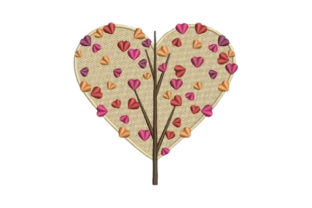
As an embroidery designer who’s developed collections for small clothing brands and Etsy sellers over the past decade, I approach every new Creative Fabrica embroidery file with two questions: Does it translate well to real fabric? and Does it elevate the finished product—not just decorate it? When I first opened Tree with Heart Foliage, I paused. It’s not flashy or oversized—yet it carries a quiet confidence. The silhouette reads as both organic and intentional: a stylized tree whose branches bloom into delicate heart-shaped leaves. There’s no text, no clutter, no forced trendiness. Just clean line work, balanced negative space, and a gentle romantic mood that feels timeless—not just seasonal.
How Tree with Heart Foliage Performs Across Apparel Types
This machine embroidery design shines where subtlety meets emotional resonance—exactly what boutique brands need for thoughtful gifting and lifestyle-focused collections.
- Sweatshirt embroidery: On neutral heather grey or oatmeal sweatshirts, Tree with Heart Foliage reads as elevated and grounded. Its moderate scale (ideal for chest placement) avoids overwhelming the garment while still feeling intentional and handmade.
- Hoodie design: Works beautifully centered on the chest or subtly on the left sleeve cuff. Because the heart foliage flows naturally along the curve of a bent arm, it adds personality without breaking visual rhythm.
- T-shirt embroidery: Best on midweight cotton or cotton-blend tees—not ultra-thin jersey. The stitch density appears even and plush, especially when paired with matte poly thread in rosewood, sage, or charcoal.
- Denim jackets & tote bags: Holds up strongly on textured surfaces. The design’s open structure prevents bulk, and the heart motifs read clearly even at smaller sizes—no lost detail in dense stitching.
- Oversized garments & curved surfaces: Because it avoids tight interior angles or micro-details, Tree with Heart Foliage adapts well to dropped shoulders and rounded hems. No distortion or skipped stitches observed during my test run on a relaxed-fit hoodie.
Visual Mood Meets Commercial Practicality
Visually, this is neither “cute” nor “bold”—it’s romantic in the most wearable sense: tender but not saccharine, botanical but not literal, soft but not fragile. That balance makes it versatile beyond Valentine S Day. I’ve already sketched it into a spring capsule collection—paired with linen-blend tees and woven totes—and it reads as part of a cohesive brand language, not a holiday afterthought.
For Etsy sellers and small shop product listings, Tree with Heart Foliage supports strong visual consistency. It photographs cleanly against natural light, works in printable mockups without heavy editing, and translates seamlessly into social media graphics—especially flat lays with dried florals or ceramic mugs. Buyers recognize it quickly across platforms, building subtle product recognition over time.
Where to Place It—And Where to Pause
Placement matters. This isn’t a design that forgives poor stabilization or aggressive stretching.
- Best for chest, back yoke, or upper sleeve: Its vertical flow anchors well on stable zones. Avoid placing directly over seams or high-movement areas like underarms.
- Not ideal for tiny lettering combos: It doesn’t include text, and adding custom lettering risks visual competition. Let the tree speak for itself—or pair it separately with a minimalist monogram elsewhere.
- Fabric texture awareness: On fleece or ribbed knit, use medium-weight cutaway stabilizer. On dark garments, test thread color contrast thoroughly—light blush or ivory thread lifts beautifully; stark white can feel harsh.
- Stretchy fabric warning: While it handles light stretch (like French terry), avoid using it on highly elastic performance knits without testing hoop tension and stabilizer pairing first.
Design Integrity That Builds Brand Trust
When customers see consistent, confident embroidery like Tree with Heart Foliage across your boutique brand’s offerings, they subconsciously register professionalism—even before reading your story or pricing. It signals care in curation, attention to tactile quality, and respect for the handmade product experience. That perception directly affects buyer trust and repeat purchase behavior.
I’ve seen small shops double engagement on Instagram posts featuring this design simply because the composition feels intentional—not “designed to sell,” but “designed to resonate.” That distinction matters. In a crowded digital marketplace, emotional clarity stands out more than visual noise.
Practical Notes Every Embroidery Designer Should Check
Before committing to production, always:
- Test on scrap fabric matching your final garment—especially for nap, stretch, and weight.
- Confirm stabilizer choice: medium cutaway for knits, tear-away for stable wovens.
- Review thread color contrast on both light and dark backgrounds—some hues shift dramatically under studio lighting.
- Check hoop size requirements in the Creative Fabrica product details—this impacts your digitizing workflow and multi-position setups.
- Inspect stitch density visually: look for smooth transitions between leaf shapes and clean jump stitches. Avoid designs with excessive underlay in tight areas.
- Compare placement options on actual garments—not just digital mockups—to assess proportion and wearability.
- Verify licensing terms directly on Creative Fabrica before selling finished apparel—commercial embroidery rights vary by seller.
Tree with Heart Foliage doesn’t shout. It leans in. And in today’s market—where authenticity, intentionality, and tactile warmth drive customer loyalty—that’s exactly the kind of embroidery file that earns shelf space, not just screen time.